IAG, DFW, All Nippon Airways, MUC, Turkish Airlines and Japan Airport Terminal among winners in FTE Global Pioneer Awards 2026
The following article was published by Future Travel Experience
International Airlines Group, Dallas Fort Worth International Airport, All Nippon Airways, Munich Airport, Turkish Airlines and Japan Airport Terminal Co., Ltd. were recognised in the FTE Global 2026 Pioneer Awards ceremony.
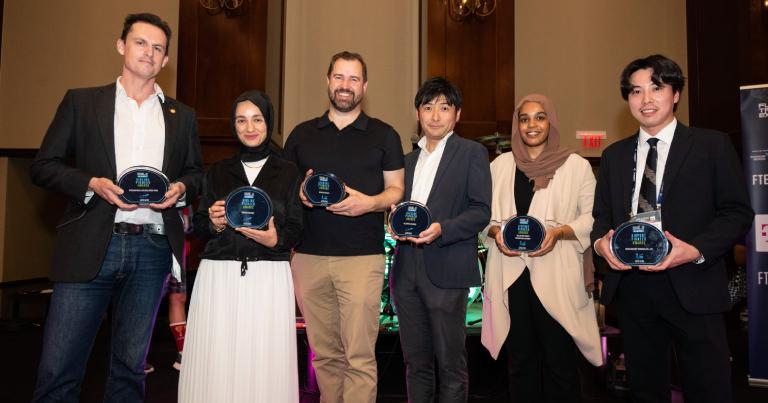
The world’s most pioneering airlines and airports were recognised for their outstanding efforts to transform the passenger experience and define the future of the air transport industry at the Future Travel Experience Global 2026 Pioneer Awards ceremony, which took place on 8 September in Dallas, Texas. The awards ceremony took place during the FTE Global 2026 Networking Welcome Party, sponsored by T-Mobile for Business, with the industry-leading FTE Global Pioneer Awards ceremony sponsored by Assaia.
Mark your diary for FTE Global 2027 – 7 to 9 September, Las Vegas >>FTE Global Airline Pioneer Awards
International Airlines Group
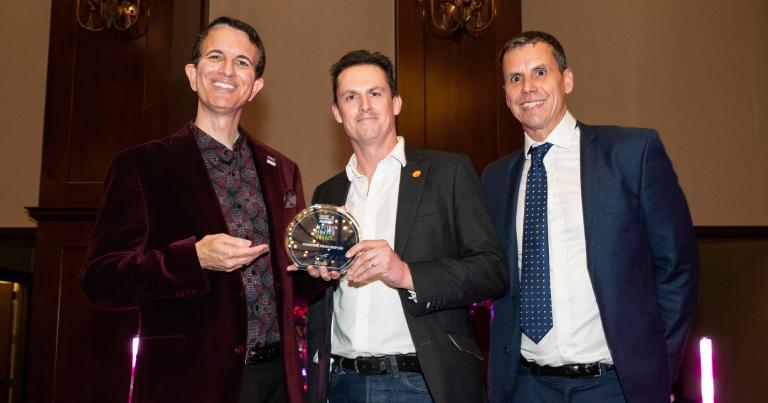
International Airlines Group (IAG) – a Corporate Partner of the FTE Digital, Innovation & Startup Hub – was recognised for embedding innovation at the heart of its transformation strategy, using emerging technology, open innovation and Group-wide collaboration to enhance customer experience, improve operational efficiency and support more sustainable aviation. Its initiatives span artificial intelligence (AI), automation, connectivity, baggage, aircraft maintenance and fuel efficiency, creating pathways for technologies to move from experimentation into real-world deployment across its airlines.
A key element is the IAGi Accelerator, which has partnered with more than 120 companies since launch. In 2025, a record 29 startups from 11 countries joined the programme, including 14 companies on the Deploy Track undertaking 12-week proofs of concept with IAG operating companies. Many participants progress to extended trials, commercial agreements or investment through IAGi Ventures, creating a clear route from promising technology to aviation-scale deployment.
One example is AISmartPlan, which partnered with Aer Lingus to transform aircraft maintenance production planning. Its AI-powered platform combines flight schedules, aircraft availability and workforce constraints to generate optimised maintenance plans, reducing a process that previously took hours each day to one completed in minutes. Following a successful proof of concept, AISmartPlan has signed a multi-year commercial agreement with Aer Lingus, with potential to scale across IAG.
IAG is also investing in technologies with sustainability potential. Through IAGi Ventures, it has invested in MAKO, developer of Flightfilm, a shark skin-inspired adhesive film designed to reduce aircraft drag and potentially cut fuel consumption, emissions and operating costs. A pilot with an IAG airline is planned, subject to successful trials and certification.
Meanwhile, IAG’s partnership with Starlink will bring high-speed inflight WiFi to more than 500 aircraft across Aer Lingus, British Airways, Iberia, LEVEL and Vueling, significantly enhancing onboard connectivity.
IAG is also applying technology to baggage through biometrics, enhanced tracking and self-service tools, providing faster information and more proactive support during disruption.
By connecting its accelerator, venture investment and airline operations, IAG has created an innovation ecosystem designed not simply to identify emerging technologies, but to test, refine and scale those capable of delivering measurable improvements across aviation.
All Nippon Airways
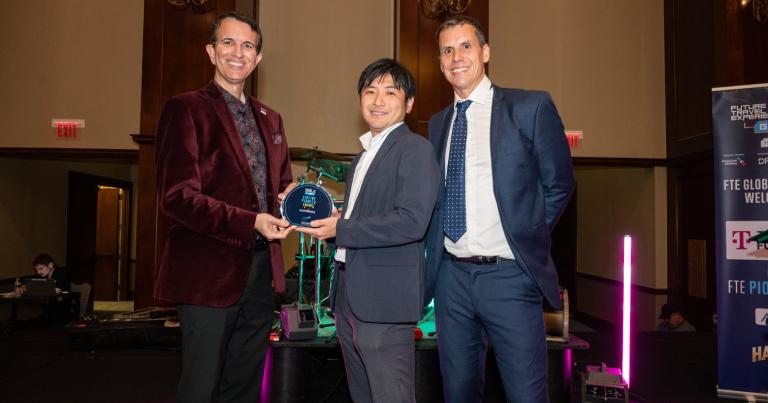
All Nippon Airways (ANA) – a Partner of the FTE Baggage Innovation Working Group – was recognised for taking a pioneering approach to transforming airport and aircraft turnaround operations through automation, artificial intelligence (AI) and human-machine collaboration. At the heart of this journey is ANA’s participation in the FTE Smart Ramp initiative, which aims to make aircraft turnaround increasingly autonomous, efficient and sustainable.
ANA’s contribution centres on autonomous towing tractors for cargo transportation, designed to move cargo between the warehouse and apron with reduced manual intervention. Following extensive Proof of Concept testing, the autonomous towing tractor entered operational use in 2025, providing valuable insight into the practical challenges of deploying autonomous vehicles in complex ramp environments while demonstrating how robotics can work alongside ground handling personnel.
For ANA, Smart Ramp is about more than individual vehicles. The airline is working with industry partners and the Japan Civil Aviation Bureau (JCAB) to help establish the infrastructure, operational guidance and regulatory framework required for autonomous airport operations at scale. Its human-centred approach recognises that successful automation depends on involving the employees who understand ramp operations and co-creating new ways of working with them.
ANA sees this collaborative model as a potential milestone towards a fundamentally different turnaround operation by 2030, in which autonomous vehicles and people work together to improve safety, productivity and sustainability.
Alongside its work in autonomous ground operations, ANA is pioneering AI for flight safety. The airline became the first in the world to implement an AI-based turbulence prediction service developed by BlueWX, using deep learning trained on a decade of turbulence data. The model achieved 86% accuracy and was validated through trials involving around 2,500 ANA pilots before integration into the airline’s weather data infrastructure. By enabling crews to anticipate turbulence more accurately, the system has the potential to improve passenger comfort and safety while reducing disruption and associated costs.
ANA is also advancing its ANA Smart Travel proposition, enabling passengers to use their smartphones throughout their journey for a smoother, increasingly contactless experience.
Together, ANA’s autonomous ramp programme, AI-powered turbulence prediction and digital passenger services demonstrate a clear strategy of harmonious human-technology collaboration – using intelligent machines to reduce repetitive work and improve decision-making while empowering employees and enhancing the passenger experience.
Turkish Airlines

Turkish Airlines was recognised for pursuing an ambitious digital transformation strategy with the goal of ranking among the top three global airlines for digital passenger experience. With its centennial in 2033 as a long-term milestone, the airline is investing across artificial intelligence (AI), airline retailing, fintech, biometrics and connectivity to create a more personalised digital journey while strengthening the resilience of its 24/7 operations. Turkish Technology, its technology-focused subsidiary with more than 1,500 employees, plays a central role in developing the capabilities underpinning this transformation.
As part of its comprehensive innovation efforts, the Turkish Airlines Venture Capital Investment Fund was launched in May 2026. This backs early-stage startups focusing on AI, mobility, sustainability, and digital aviation services.
A key focus is modern airline retailing. Turkish Technology has developed a merchandising layer on top of its in-house passenger service system, bringing offer composition, bundling and pricing flexibility together. This enables Turkish Airlines to create contextual offers based on passenger, segment and service characteristics, with dynamic Business Class upgrades already responding to factors such as load, timing and passenger context. Similar capabilities are being extended across ancillary products, marking a shift from traditional fare construction towards more flexible, personalised offer construction throughout the journey.
The airline is also preparing for the growing role of AI-powered travel interfaces. By developing its own underlying capability to construct and manage differentiated offers, Turkish Airlines aims to ensure that emerging AI assistants can present structured, contextual products while the airline retains control of its commercial proposition.
Across the passenger journey, TK Wallet simplifies payment and refunds for Miles&Smiles members, while partnerships with Google and Samsung enable baggage tracking through Find Hub and SmartThings Find. Turkish Airlines is also exploring biometrics, robotics and automation in baggage handling and aircraft turnarounds, with technology designed to augment rather than replace employees.
Connectivity is another major focus. More than 100 narrowbody aircraft are being upgraded through a partnership with Anuvu and Profen, with AI-powered network management delivering more stable connections during periods of high demand. Deployed aircraft have recorded more than nine-fold higher throughput, four-times faster upload speeds and around 25% lower latency.
Together, these initiatives demonstrate Turkish Airlines’ ambition to build a more intelligent, resilient and personalised digital airline, combining control of its core technology and commercial proposition with strategic partnerships to enhance the passenger experience at every touchpoint.
FTE Global Airport Pioneer Awards
Dallas Fort Worth International Airport

Dallas Fort Worth International Airport (DFW) – a Corporate Partner of the FTE Digital, Innovation & Startup Hub – was recognised for continuing to make digital transformation a central pillar of its Travel. Transformed strategy, with a clear ambition to reinvent how the airport operates while delivering more seamless, personalised and efficient experiences.
DFW is embracing artificial intelligence (AI), machine learning, autonomous mobility, connectivity and data-driven operations. Its ground-breaking Digital Twin is enabling proactive, real-time decision-making to support sustainability, efficiency and resilience. Meanwhile, DFW is working with Copenhagen Optimization on a cloud-based Resource Management System spanning baggage handling, check-in and gate management. By integrating multiple data sources, the platform will enable real-time optimisation, rapid re-planning during disruption, capacity planning and scenario analysis.
Digital tools are also being placed directly in passengers’ hands. The myDFW ecosystem and DFW Airport app provide real-time parking availability, Prebook Parking, security wait times, flight updates, interactive maps and dining and shopping information. With more than 900,000 travellers using a myDFW account and the app, the launch of myDFW Rewards adds a personalised loyalty dimension, allowing Prebooked Parking customers to earn points towards future savings.
Connectivity is another foundation of DFW’s digital strategy. A partnership with AT&T includes a $10 million investment to modernise wireless infrastructure and expand free public WiFi, while a private 5G network is supporting new Internet of Things (IoT) applications and connected operational use cases. Smart signage is also being deployed to provide more dynamic, data-driven airport communications.
DFW is combining this digital transformation with major physical investment. Together with American Airlines, it has opened nine new gates as part of the Terminal C redevelopment, featuring electronic boarding gates, enhanced wayfinding, expanded seating, power stations and upgraded concessions. Modular construction is helping accelerate delivery while minimising operational disruption. This forms part of the wider DFW Forward programme, with $12 billion being invested to modernise and expand the airport.
Underpinning DFW’s approach is collaborative innovation, including participation in the Airports for Innovation network and partnerships with airlines, technology companies, governments and startups.
Together, these initiatives demonstrate a holistic vision for the digital airport, combining AI, real-time data, connected infrastructure and smart passenger services to create a more responsive, flexible and customer-focused journey from curb to gate.
Munich Airport

Munich Airport – a Corporate Partner of the FTE Digital, Innovation & Startup Hub – was recognised for strengthening its position as a Premium Innovation Hub, combining advanced technology with industry partnerships and a human-centred approach to digital transformation. Its strategy focuses on using robotics, automation and artificial intelligence (AI) not simply to automate existing processes, but to empower employees, improve operational efficiency and create a more seamless passenger experience.
A major focus is the deployment of collaborative robotics and autonomous systems across the airport. Service robots including JEEVES, a self-driving robot delivering snacks and beverages, and Ottobot, an autonomous passenger assistant providing information, rebooking and refund support, are demonstrating how robotics can work alongside employees to enhance customer service. In partnership with Fraunhofer IML, Munich Airport is also pioneering BagBOT and evoBOT, robotic systems designed to support aircraft loading and unloading, handle hazardous goods and reduce the physical burden of heavy lifting.
Meanwhile, Munich Airport is increasingly applying AI, generative AI, process mining and data-driven decision-making to optimise operations. AI-supported turnaround management and real-time asset tracking help employees make faster decisions, while the Next Best Process project combines process mining and AI to identify opportunities to improve operational speed and efficiency. Its AIRHART platform and corporate data lake bring together previously disparate data sources, supporting predictive incident management and AI-driven decision-making.
Collaboration is central to this strategy. Munich Airport participates in the Airports for Innovation network and FTE Smart Ramp initiative, exploring how robotics, automation and autonomous vehicles can transform aircraft turnaround. Its MUC2030 innovation roadmap and Loyalty Hub partnership with Lufthansa and Miles & More are also using collaboration, data sharing and digital services to create more personalised passenger experiences.
The airport’s LabCampus provides a real-world testbed where startups, research institutions and established companies can develop and test smart infrastructure, digital services and mobility concepts in an operational airport environment.
Together, these initiatives demonstrate Munich Airport’s vision of technology and people working hand-in-hand. By using intelligent automation to reduce physical strain, simplify tasks and give employees better information and tools, Munich Airport is building a more efficient, resilient and passenger-centric airport while reinforcing its position at the forefront of aviation innovation.
Japan Airport Terminal Co., Ltd.
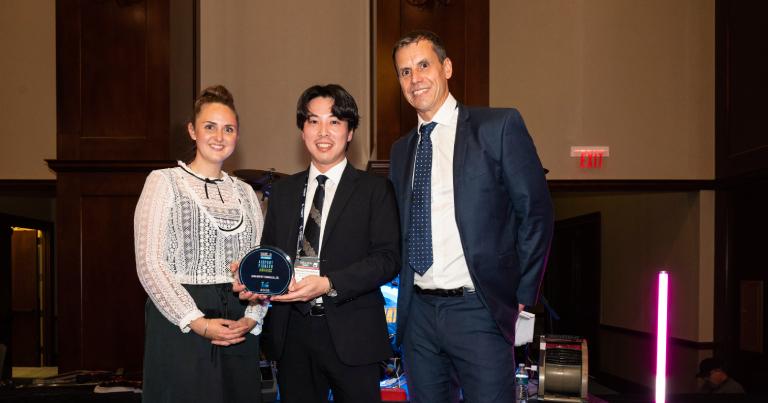
Japan Airport Terminal – the organisation responsible for the construction, management and operation of Haneda Airport’s terminals – was recognised for being at the forefront of airport innovation through its visionary “terminal.0 HANEDA” initiative. This ambitious cross-industry collaboration brings together technology companies, startups and industry stakeholders to reimagine the airport of the future, focusing on cutting-edge technology, sustainability, operational efficiency and passenger experience. The FTE World Innovation Summit, hosted by Haneda Airport, will take place in Tokyo, Japan, on 1-3 March 2027, bringing the global aviation and innovation community together in one of the world’s leading technology hubs.
At the heart of terminal.0 HANEDA is the ambition to develop practical, scalable solutions that can be deployed not only at Haneda but at airports worldwide. The initiative is exploring artificial intelligence (AI), robotics, automation, biometrics and the Internet of Things (IoT) to create a smarter, more seamless passenger journey. AI could enable the airport to predict passenger flows and peak periods, allowing staffing and resources to be allocated proactively, while robotics and automation can support areas such as baggage handling. Biometric technologies, including facial recognition, also have the potential to streamline processes from check-in and security through to boarding.
Sustainability is another core pillar, with terminal.0 HANEDA exploring green technologies, energy-efficient infrastructure and waste-reduction initiatives. The organisation’s commitment is also reflected in the planned opening of the Terminal 1 North Satellite facility on 1 September 2026, featuring a hybrid timber-and-steel structure designed with carbon neutrality in mind.
Crucially, Japan Airport Terminal’s approach is based on collaboration and co-creation, using Haneda as a living testbed where airports, airlines, technology companies and startups can identify challenges, test concepts and develop solutions with potential for wider deployment.
Through terminal.0 HANEDA and its wider innovation programme, Japan Airport Terminal is demonstrating how airports can combine AI, automation, biometrics, connected infrastructure and sustainable design with a strong focus on human experience. As host of FTE World Innovation Summit 2027, it will also provide a global platform for exploring the technologies and ideas shaping the airports of tomorrow.
Mark your diary for FTE Global 2027 – 7 to 9 September, Las Vegas >>You may also be interested in
12 technology and CX trends that can enhance airline and airport operations in 2026
Making travel more human: Virgin Voyages on AI, hospitality and reimagining the passenger experience
FTE World Innovation Summit relocates to Tokyo for 2027 edition hosted by Haneda Airport – 1-3 March
Article originally published here:
IAG, DFW, All Nippon Airways, MUC, Turkish Airlines and Japan Airport Terminal among winners in FTE Global Pioneer Awards 2026
from Future Travel Experience https://ift.tt/VZF3Gn0
Comments
Post a Comment